Every region of India gave Ayurveda something of its own. classical's gift was thoroughness with fats. In the narrow, humid strip between the Western Ghats and the Arabian Sea, physicians spent centuries refining how botanicals could be carried into preparations for the body, and the Kuzhambu, the semi-solid preparation on a three-fat base, is one of the most distinctive results. It is not an oil, it never was, and its history explains why. This article traces the format from the classical compendia through the Vaidya households to the jars prepared today.
The classical stream: texts behind the tradition
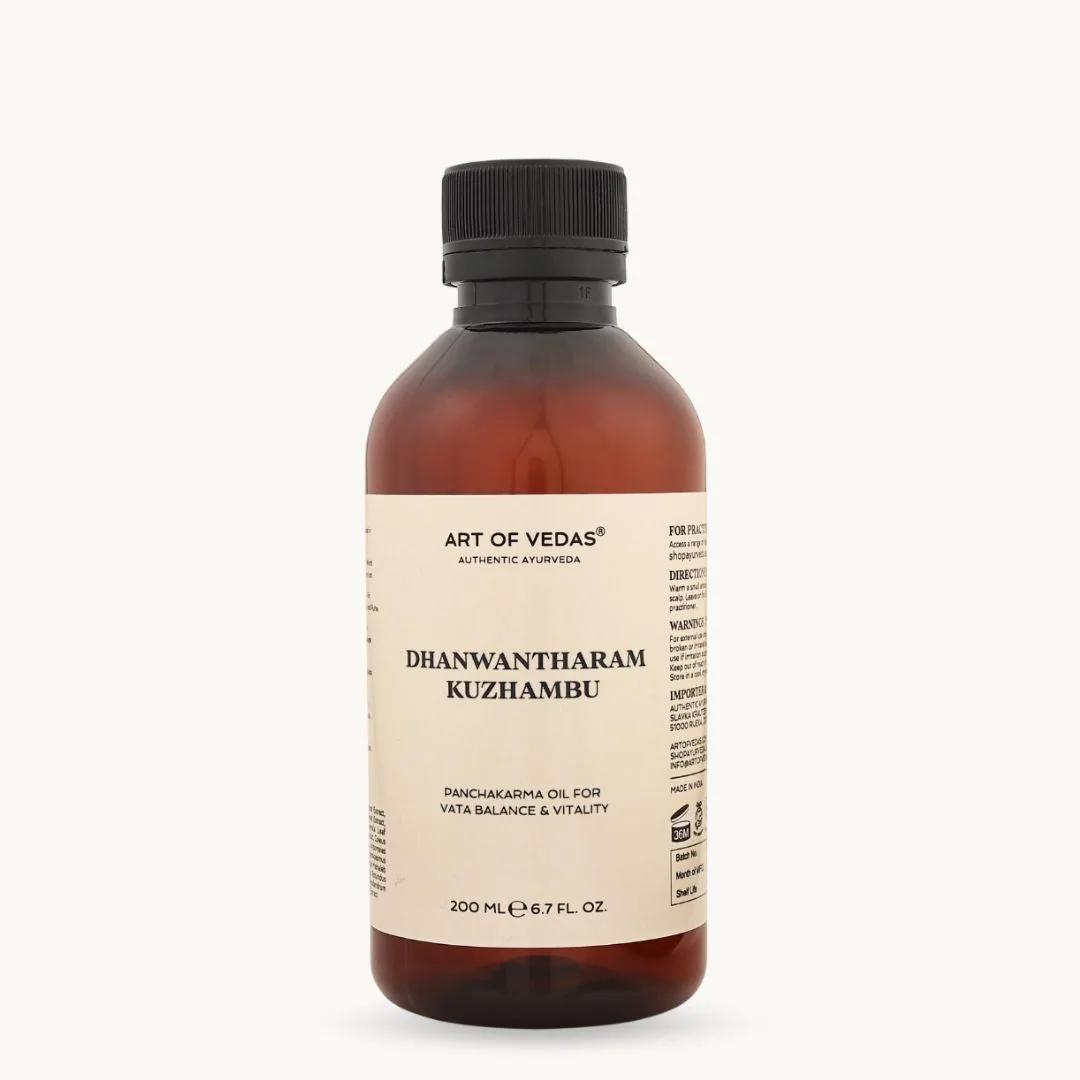
classical's medical tradition is anchored in the classical literature of Ayurveda, above all the Ashtanga Hridayam of Vagbhata, the text the region's physician families made their daily companion. Around and after it grew a distinctly regional literature, of which Sahasrayogam, the "thousand formulations", is the most famous: a working compendium of recipes compiled over generations, dense with the oils, Kuzhambus and other preparations that classical practice actually used. The formulations were not theoretical. They record base fats, decoctions, pastes and methods with the brevity of instructions meant for people who cooked them weekly. Many of the preparations offered by Art of Vedas descend directly from this recorded lineage, among them the Dhanwantharam family, whose semi-solid form, Dhanwantharam Kuzhambu, remains a household staple.
The Vaidya household: where the format was kept alive
Between the texts and the present stand the physician families, the Vaidyas, including the celebrated Ashtavaidya lineages of classical. In their households the preparation of oils and Kuzhambus was seasonal, domestic work: decoctions simmered in the courtyard, fresh pastes ground by hand, the slow reduction over a wood fire judged by eye, ear and touch. The semi-solid format earned its permanent place in this world for practical reasons that have not changed:
- It stays on the applied area, suiting the targeted, local work classical massage favours
- It absorbs slowly, matching the unhurried pace of household and therapy routines
- It travels and keeps well in a jar, in a climate that punishes carelessness
- It concentrates a full formula into small, measured servings
- It extends the same recorded formulas into a second, denser texture beside the oil
What is actually in a classical Kuzhambu
The recorded method is consistent across the centuries. A base of three fats, classically sesame, coconut and castor, receives the formula's botanicals in two forms: a Kashayam, the water decoction, and a Kalka, the fresh-ground paste. The whole is cooked patiently until the water has left and only the enriched fats remain, cooling to the soft, dense set that gives the format its Malayalam name. The full process, stage by stage, is described in our article on how a Kuzhambu is made, and the definitional short answer lives at what is Kuzhambu.
From courtyard to jar
The tradition did not stay in the courtyard. classical's preparations travelled with its physicians and, in time, with its diaspora, and the formulas were carried into regulated modern production without surrendering their method. Alongside the Kuzhambus, the same stream carried classical's other signatures, among them Murivenna, the coconut-based classical preparation whose story we tell in our guide to Murivenna, and the Murivenna jar on the modern shelf is recognisably the same formula the households kept. What changed is scale and consistency; what remained is the three-fat logic, the decoction and paste, and the patience.
Frequently Asked Questions
How old is the Kuzhambu format?
The format belongs to classical's classical tradition and appears throughout its compiled literature, notably Sahasrayogam. Precise dating of these compilations is a scholarly question; the practice they record spans many generations.
What does the word "Kuzhambu" mean?
It is Malayalam and describes a thick, semi-solid consistency. In the classical pharmacy it names the class of preparations that set soft rather than pour.
Is a Kuzhambu older or newer than the Thailam?
The two formats grew side by side in the same literature as textures of the same formulas. Neither is a modern derivative of the other.
Why three fats instead of one?
Tradition assigns each fat a role: sesame as the classical warming base, coconut as classical's cooling contribution, castor for its heavy, penetrating character. Together they set semi-solid.
Are today's Kuzhambus made from the classical recipes?
Classical preparations follow the recorded formulations, adapted to modern quality and safety requirements. The named formulas, Dhanwantharam among them, keep their textual identity.
This article describes the history of traditional Ayurvedic preparations for general information. It is not medical advice, and it makes no claims about the effects of any preparation. For personal guidance, please consult a qualified professional.